Side by side in central London, just a short walk apart, sit two of Britain's most important railway stations. London King's Cross and London Euston are the starting blocks for two mighty railway arteries that race northwards, carrying millions of people every year. These are the East Coast and West Coast Main Lines. Each has its own distinct character, its own story, and its own special views from the window. Choosing between them for a family trip to North England or Scotland can feel like picking a favourite. But they are not the same. One is a route of cathedrals and coastlines, the other a twisting passage across wild fells and through industrial heartlands. So, which adventure is the right one for you?
The Routes at a Glance
At first glance on a map, the two lines look quite similar. They both start in London and end in Scotland, forming the twin backbones of the nation's rail network. The differences are in the details, the places they visit, and the very ground they cover.
The East Coast Main Line (ECML) This is the straighter, and often faster, of the two routes. From London King's Cross, it travels north across Hertfordshire and Cambridgeshire, over the flat Fens to Peterborough. It then powers north, clipping the edge of Lincolnshire before reaching the historic railway heartlands of South Yorkshire and beyond, calling at major cities like Doncaster, York, and Darlington. From there, it continues up to Newcastle upon Tyne, runs along the scenic Northumberland coast, and crosses the River Tweed into Scotland at Berwick. The final stretch takes it through the gentle countryside of the Borders and into its grand terminus at Edinburgh Waverley. The primary operator of the high-speed services is LNER (London North Eastern Railway). The full list of stops is in our East Coast Main Line guide.
The West Coast Main Line (WCML) This route is a story of curves and climbs. Starting from London Euston, it heads north west out of the capital, crossing the home counties and the Midlands, serving Birmingham. The line then pushes on to the great railway hub of Crewe, where it splits. One branch heads to Manchester, while the main line continues north to serve Liverpool, Preston, and Lancaster. Its most dramatic section involves the steep climb over Shap Fell in Cumbria, a real test for any train. After calling at Carlisle, it crosses into Scotland and tackles another great summit at Beattock before descending into the Clyde Valley and arriving at Glasgow Central. High-speed services are run by Avanti West Coast. If you want every calling point in order, we've listed them all in our West Coast Main Line stations guide.
The London Terminals: A Tale of Two Stations
Your journey's beginning sets the tone, and the two London stations could not be more different.
London King's Cross is an impressive building. After a huge restoration project, it is now a wonderful blend of Victorian grandeur and modern design. The original 1852 train shed, with its twin-arched roof, is a magnificent sight. But the star of the show for many is the Western Concourse, a striking web of white steel that swoops up to form a spectacular semi-circular roof. For younger travellers, of course, the station's main draw is the trolley disappearing into a wall at Platform 9¾. It is a place of light, history, and a little bit of magic.
London Euston is a far more practical affair. It was London's first ever inter-city station, but the original, much-loved building with its famous Doric Arch was controversially demolished in the 1960s. The station that replaced it is a product of its time, a low, functional building designed to get lots of people to their trains efficiently. While it lacks the architectural charm of its neighbour, it does its job very well. It is a station about purpose and the promise of departure, a place where the adventure begins the moment the train starts to move.
The Journey North: Scenery from the Window
This is where the two lines truly show their different personalities. What you see from your seat is the heart of the experience.
East Coast: Cathedrals and Coastlines
The ECML is built for speed. Its southern sections are famously straight and level, a perfect racetrack for the high-speed trains championed by engineers like the LNER's Sir Nigel Gresley. As you leave London, the view of commuter towns gives way to the vast, flat expanse of the Fens. The skies feel enormous out here, and you get a real sense of the train's velocity as it arrows northwards. Keep an eye out for the towers of Peterborough and Ely Cathedrals rising above the flat landscape.
Further north, the journey's character changes. The approach to Durham is, without doubt, one of the most memorable sights on the entire British railway network. The train slows to cross the high viaduct, and suddenly, to your left, the remarkable view of Durham Cathedral and Castle appears, perched high on a peninsula above the River Wear. It is a moment that makes everyone look up from their book or screen.
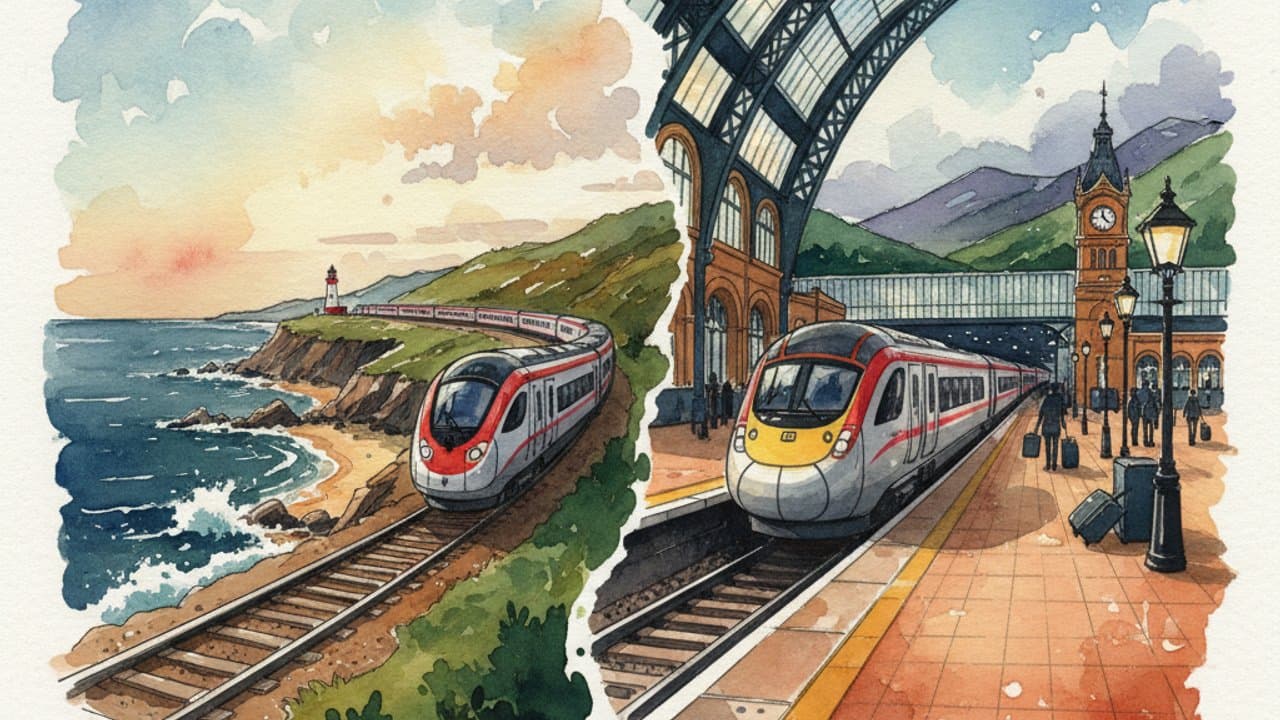
But the ECML saves its best for the final stretch in England. North of Newcastle, the railway line meets the sea. For mile after pleasant mile, the train hugs the Northumberland coastline. You will see sandy beaches, rocky coves, and the waves of the North Sea just a stone's throw from your window. Look out for a distant view of Lindisfarne, or Holy Island, with its causeway covered by the tide. It is a very beautiful part of the country, and seeing it from the train is a special treat.
West Coast: Fells and Uplands
The WCML's scenery takes a little longer to get going, but it is well worth the wait. The route out of London and across the Midlands is a mix of rolling hills and busy urban landscapes. The route was pieced together in sections by the great engineers of the railway age. It navigates a more challenging landscape than its eastern rival, which explains its many more curves.
It is after Preston and Lancaster that the scenery becomes truly compelling. Here, the train begins the long, arduous climb into Cumbria and the Lake District National Park. This is the ascent to Shap summit, a significant challenge in the age of steam trains. From your window, the scenery transforms into a rugged world of high fells, green valleys, and old stone walls. You can see the peaks of the Lake District in the distance as the train labours up the gradient. It feels wild and remote, a powerful contrast to the gentler views of the East Coast.
After a brief stop in Carlisle, the train enters Scotland and prepares for another mighty climb. The line twists and turns its way up across the Southern Uplands to Beattock Summit. This is another wonderfully remote and atmospheric part of the journey, with the railway line dwarfed by the surrounding hills. The long descent from the summit into the Clyde Valley signals the final approach to Glasgow Central, taking you from wild moorland back to civilisation.
The Trains Themselves: Azumas vs Pendolinos
The trains that run on these lines are just as distinct as the routes they travel.
On the East Coast, you will be riding an LNER Azuma. These are Class 800 or 801 trains, built in Britain using Japanese bullet train technology. They are sleek, modern, and very quiet. Inside, they feel bright and airy, with large windows perfect for watching the scenery. One of their cleverest features is that they are 'bi-mode'. This means they can run on electricity from the overhead wires, drawing power through their pantograph (the articulated arm on the roof), but they also have diesel engines. This allows them to travel on routes beyond the end of the electrified main line, reaching far-flung destinations like Aberdeen and Inverness.
On the West Coast, the star is the iconic Class 390 Pendolino. 'Pendolino' is Italian for 'small pendulum', and it gives a clue to what makes this train so special. To handle the WCML's many curves at high speed, the Pendolino tilts. As it enters a bend, the train's body leans into the curve by up to 8 degrees. For passengers, it is a curious and fun sensation. You feel a gentle push to one side as the view from your window banks like an aeroplane. It is this tilting technology that allows the train to maintain 125 mph on a line that would otherwise be much slower. The Pendolinos have recently been given a full interior refurbishment by Avanti, making them smarter and more comfortable than ever.
The Great Cities En Route
Of course, a train journey is not just about the ride, it is also about the destination. Both lines connect London to some of Britain's most interesting cities.
East Coast Highlights
The ECML is a roll-call of historic English cities. A major highlight is York, a city well suited for a family railway adventure. You can get off the train and walk straight to the National Railway Museum, an essential visit for any enthusiast. Beyond the railways, York offers the Viking Centre, the winding medieval streets of the Shambles, and the great York Minster. Further north, Durham is a small but perfectly formed university city dominated by its magnificent cathedral. Newcastle is an energetic centre of culture with its seven famous bridges over the River Tyne. The final stop, Edinburgh Waverley, is widely considered one of the world's most handsome cities, with its castle perched on a volcanic rock overlooking the whole scene.
West Coast Highlights
The WCML connects the major industrial centres that helped shape modern Britain. Birmingham New Street drops you in the heart of the country's second city, a place of canals, culture, and excellent shopping. Further north lie two cities with a fierce but friendly rivalry. Manchester is a centre of music, sport, and science, with an excellent museum dedicated to its industrial past. Liverpool Lime Street is the gateway to a city of maritime history, significant music heritage thanks to The Beatles, and the beautifully redeveloped Albert Dock. The line's main destination, Glasgow Central, is a rewarding city. It is a place of impressive Victorian architecture, a fine collection of free museums and art galleries, and an infectious energy.
Speed and Timings: Which is Faster?
For many, the simple question is: which train gets me there quickest? Because the East Coast Main Line is a straighter, less challenging route, it generally has the edge. The fastest LNER services can make the 393-mile journey from London King's Cross to Edinburgh Waverley in just over four hours, as you can see from LNER's official timetables.
The West Coast Main Line is slightly longer at 401 miles from London Euston to Glasgow Central. Even with the Pendolino's clever tilting technology, the winding nature of the route means the journey takes a little longer. The fastest Avanti West Coast services typically complete the trip in around four and a half hours, a timing confirmed by Avanti West Coast's timetables. Both are astonishingly fast ways to travel the length of the country, turning a long car journey into a relaxing and scenic afternoon.
The Verdict: Which Main Line Is For You?
There is no single 'best' line. The right choice depends entirely on the kind of adventure your family is looking for.
You should choose the East Coast Main Line if: * You want classic British scenery, from the fine sight of Durham Cathedral to the beautiful Northumberland coast. * Your destination is one of the great historic cities of York or Edinburgh. * You value a bright, modern train with big windows and a fast, smooth ride. * You are a history enthusiast, keen to travel the route of famous steam locomotives like Flying Scotsman and Mallard.
You should choose the West Coast Main Line if: * You are thrilled by wild, dramatic landscapes like the Cumbrian Fells and the Scottish Uplands. * You want to experience the unique sensation of a tilting Pendolino train as it speeds around curves. * You are heading for the energetic cities of Birmingham, Manchester, Liverpool, or Glasgow. * You enjoy the engineering story of a railway conquering a truly challenging landscape.
Ultimately, both journeys are classics for a reason. They represent two different, but equally compelling, ways of seeing the country. Whichever you pick, find a window seat, watch the landscape of Britain unfold, and enjoy the ride.