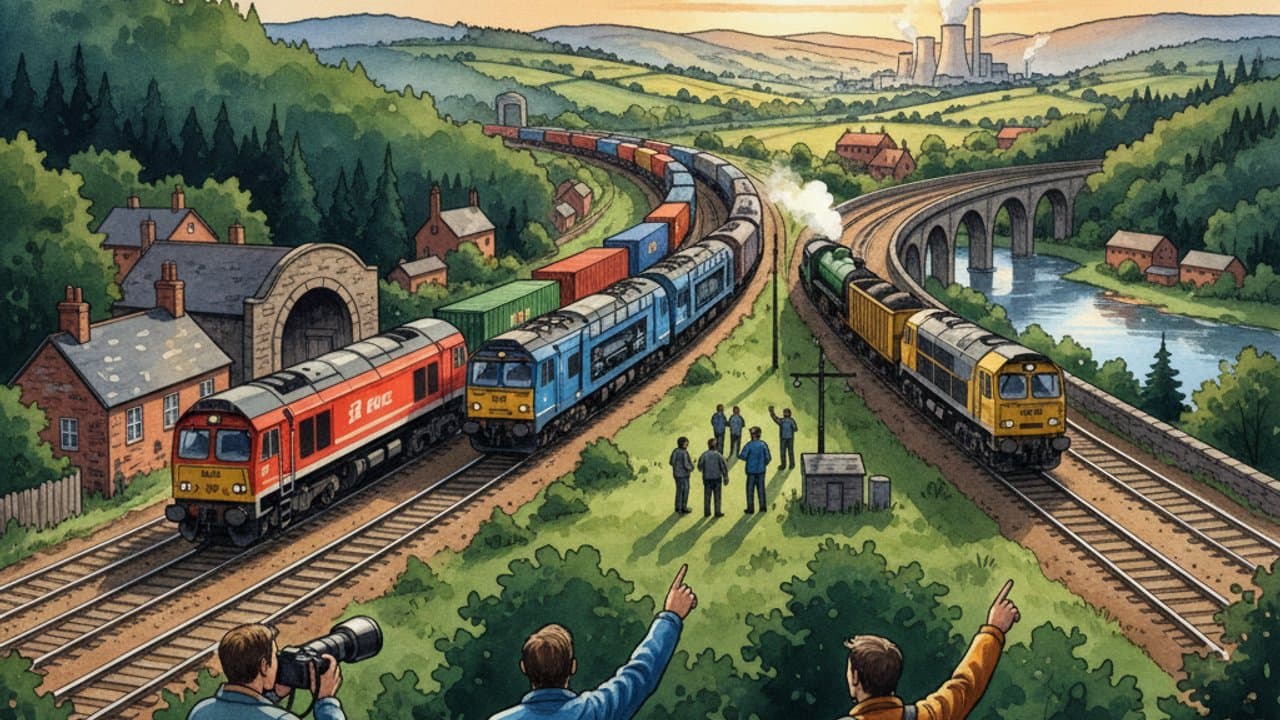
The sound is the first clue. It is not the high-pitched whine of an electric passenger train, but a deep, guttural rumble that you feel in your chest. The ground beneath your feet vibrates. Then, it appears. A huge, grimy locomotive, working hard at the head of a train that seems to stretch for a mile, its wagons filled with everything from shipping containers to brand new cars. This is rail freight in action, the powerful, heavy-duty backbone of our railway network.
While the sleek passenger services get most of the attention, there is a special kind of satisfaction in spotting freight trains. They are the workhorses of the rails, connecting ports to warehouses, quarries to construction sites, and factories to the wider world. Each train tells a story about the goods that keep our country running, and according to Network Rail, the industry transports products worth over £30 billion each year. For any young or old railway fan, learning to spot them is a rewarding hobby.
Understanding the Freight Train
Before you head out with your notebook and camera, it helps to know what you are looking for. A freight train is made up of its locomotive (the engine that provides the power) and its wagons (the unpowered vehicles that carry the goods). Both come in many different shapes and sizes.
The Locomotives: Giants of the Rails
You can often identify a freight train by its locomotive, or 'loco'. These are designed for power and reliability, not speed. Unlike passenger trains, they are almost always separate from their carriages. Here are some of the most common classes you will see, along with the companies that run them, known as Freight Operating Companies (FOCs).
- Class 66: The most common freight locomotive in the UK by a long way. You will see these everywhere. Nicknamed 'Sheds' by enthusiasts, they are owned by all the major FOCs, including DB Cargo (look for their bright red livery), Freightliner (in green and yellow), and GB Railfreight (in striking blue and orange). They are noisy, smoky, and incredibly powerful. A true icon of modern rail freight.
- Class 68: A much more modern design, often used on fast container trains and even some passenger services. They are nicknamed 'Cats' because they are powered by a Caterpillar engine. You will often see them in the dark blue of Direct Rail Services (DRS) or the silver of Chiltern Railways, where they haul passenger coaches.
- Class 70: A very distinctive looking locomotive with a large cab at one end. Run by Freightliner and Colas Rail (in their yellow and orange colours), these American-built machines are immensely powerful and are often found on the heaviest trains, like those carrying coal or stone.
- Class 88: A clever bi-mode locomotive operated by DRS. It can run as a powerful electric engine using overhead wires, but it also has a small diesel engine for moving around in depots or on non-electrified lines. It looks very similar to the Class 68.
- Class 90 and 92: These are the big electric locomotives, which draw power from a pantograph (the framework on top that touches the overhead wires). They are a common sight on the West Coast and East Coast Main Lines, pulling long container trains at high speed. You will see them in the liveries of Freightliner and even hauling the Caledonian Sleeper carriages south from Scotland.
The Wagons: What's in the Box?
Following the locomotive is the real story of the train: the wagons. Learning to identify them and guess what they are carrying is part of the fun.
- Intermodal Wagons: These are long, flat wagons designed to carry shipping containers or lorry trailers. This type of transport is called 'intermodal' because the same container can be moved between ships, trains, and lorries without being unpacked. These are the most common type of freight train, often running from ports like Felixstowe and Southampton to inland terminals across the country.
- Hopper Wagons: These have high sides and an open top, or sometimes a roof with hatches. They carry 'aggregate' materials like stone, sand, and gravel from quarries, or biomass (usually wood pellets) to power stations. Some have sloping sides at the bottom to allow the contents to be discharged easily.
- Tanker Wagons: These are easy to spot. They are long, cylindrical wagons used for carrying liquids like fuel, chemicals, or even milk and orange juice.
- Car Transporters: These are often very long, two-tier wagons, either with open sides or covered in a blue mesh. They carry new cars from factories or import docks to distribution centres.
- Nuclear Flasks: A very specialist and important cargo. DRS operates trains of just one or two heavily protected, thick-walled wagons carrying spent nuclear fuel. They move slowly and are a rare but interesting sight.
- Engineers' Trains: You will often see bright yellow wagons belonging to Network Rail. These can be anything from ballast hoppers to wagons carrying new track sections. They are a sign that work is being done to keep the railway in good shape.
Cracking the Code: Headcodes
Every train on the UK network has a unique four-character code, called a train reporting number or headcode. For spotters, the first number is the most important clue. Passenger trains usually start with a 1, 2, or 9. Freight trains, however, have their own numbers:
- 3: Parcels trains or empty passenger trains.
- 4: High-speed freight trains, often container trains, that can travel up to 75 mph.
- 6: Standard freight trains, limited to 60 mph. This covers most of the aggregate and stone trains.
- 7 & 8: Slower freight trains, limited to 45 mph or 35 mph respectively.
If you see a train approaching and its headcode starts with a 6, you know it is a heavy goods service.
Top Spots for Freight Spotting
So, where can you go to see these magnificent machines? Freight trains travel all over the country, but some locations are better than others because they are on key routes or are major junctions where different lines meet. Here are some of the best.
The Midlands: The Heart of the Network
The Midlands is a fantastic area for watching freight, as lines from all corners of Britain converge here. It is the logistical centre of the country.
Crewe, Cheshire The railway town of Crewe is perhaps the most famous freight hotspot in the country. It is a huge junction on the West Coast Main Line, with lines radiating out in all directions. You can see almost every type of freight imaginable here, from fast electric-hauled container trains to slow-moving engineers' wagons. The station platforms offer a great view, and the nearby Crewe Heritage Centre is a wonderful place to learn about the town's railway history. You might even spot a tiny Class 08 Shunter moving wagons around the yards.
Stafford, Staffordshire Just down the line from Crewe, Stafford is another key junction where lines from Birmingham, Manchester, Liverpool, and London meet. The station has long platforms that provide a safe and clear view of the action. It is a brilliant place to see the contrast between fast Avanti Pendolinos and the heavy freight services they share the tracks with.
Nuneaton, Warwickshire Nuneaton station is special because it features a rare 'flyover' where one line crosses another on a bridge. This means you can see trains on the West Coast Main Line thundering through at high speed, while a cross-country route passes overhead. This intersection of major routes brings a huge variety of freight traffic, particularly container trains.
North England: Industrial Routes and Stunning Scenery
The railways of North England were built to serve its industries, and that legacy continues today with a rich flow of freight traffic.
Doncaster, South Yorkshire Another legendary railway town, Doncaster sits on the East Coast Main Line. The station is a superb place to watch trains, with non-stop passenger and freight services passing through at speed. A huge amount of freight from the south, the ports of Immingham and Hull, and from Scotland funnels through here. The construction of the 'Doncaster North Chord' a few years ago was built specifically to give freight trains a clearer path through the busy junction.
Darlington, County Durham As one of the birthplaces of the railway, Darlington remains a vital part of the network. It is another key station on the East Coast Main Line, and its platforms offer a grandstand view of the constant flow of traffic. Look out for container trains and heavy trains carrying steel products from the industries in nearby Teesside.
The Settle to Carlisle Line This famous line is not just for tourists and steam trains. It is a vital freight artery, especially when other lines are closed for engineering work. It is used daily by trains carrying limestone from a quarry in the Ribble Valley. Seeing a heavy Class 66 hauling a long line of hopper wagons over the magnificent Ribblehead Viaduct is one of the greatest sights in British railways. Stations like Settle, Horton-in-Ribblesdale, or Carlisle at the northern end are good places to wait.
South England: From Ports to Power Stations
The busy ports and quarries of South England generate a huge amount of rail freight traffic.
Didcot Parkway, Oxfordshire Situated on the Great Western Main Line, Didcot Parkway is an excellent spot. It sees a constant stream of the latest passenger trains, but it is also on the main route for container trains travelling from the port of Southampton to the Midlands. Furthermore, it sits at the junction for a line that serves the huge limestone quarries of the Mendip Hills, so you will see very long and heavy stone trains rumbling through.
Eastleigh, Hampshire Just north of Southampton, Eastleigh is a major railway town with a large works and yard. The station is a bottleneck for all services heading to and from Southampton's busy container port, so you are guaranteed to see Freightliner's heavy-haul locos at work. It is a brilliant place to appreciate the scale of modern logistics.
Ipswich, Suffolk The main line to Ipswich is the key route for trains serving Felixstowe, the UK's busiest container port. A huge proportion of the goods you see in shops arrive in the country here. Dozens of container trains leave the port every single day, and they all pass through Ipswich. Stations just outside the town, like Trimley, offer a great close-up view of the action.
Scotland and Wales
Our guide would not be complete without a look at the freight scenes in Scotland and Wales.
Carstairs, South Lanarkshire This is a key junction in central Scotland where the West Coast Main Line from England splits, with one line going to Glasgow and the other to Edinburgh. All cross-border freight has to pass through here, making it a busy and important location for spotters.
Newport, South Wales On the South Wales Main Line, Newport is an ideal place to see the freight traffic that serves the region's industries. This includes steel trains from the giant Port Talbot steelworks and container trains from ports on the Severn estuary. The station at Cardiff Central is also an excellent vantage point.
Your First Freight Spotting Adventure: Top Tips
Ready to get started? Here are a few things to keep in mind.
- Safety First, Always. This is the most important rule. Railways are dangerous places. Never trespass on the tracks or go anywhere you are not supposed to be. Always stand back from the platform edge. Modern trains are quieter than you think and can approach very quickly. Remember to pay attention to station announcements and staff instructions.
- Check the Timetable (Sort Of). Freight trains do run to a schedule, but they can be less predictable than passenger services. A good tip is to use a real-time train tracking website or app on your phone. These show you every train on the network, including freight, so you can see what is due to pass your location.
- Be Patient. Sometimes you might have to wait a while between freight movements. Use the time to watch the passenger trains, or bring a book. The reward of seeing a huge Class 70 or a colourful GBRf Class 66 is worth the wait.
- Wrap Up Warm. Even on a sunny day, a station platform can be a windy and cold place to stand for a long time. It is always a good idea to bring an extra layer and maybe a flask with a warm drink.
Spotting freight trains offers a different perspective on our railways. It connects you to the vast, unseen network of industry and logistics that is always on the move, day and night. Each train is a puzzle, a story of where it has come from and where it is going. And remember, every single freight train you see takes dozens of lorries off our congested roads, making the air cleaner and our motorways safer. All you have to do is find a safe spot, wait, and watch.