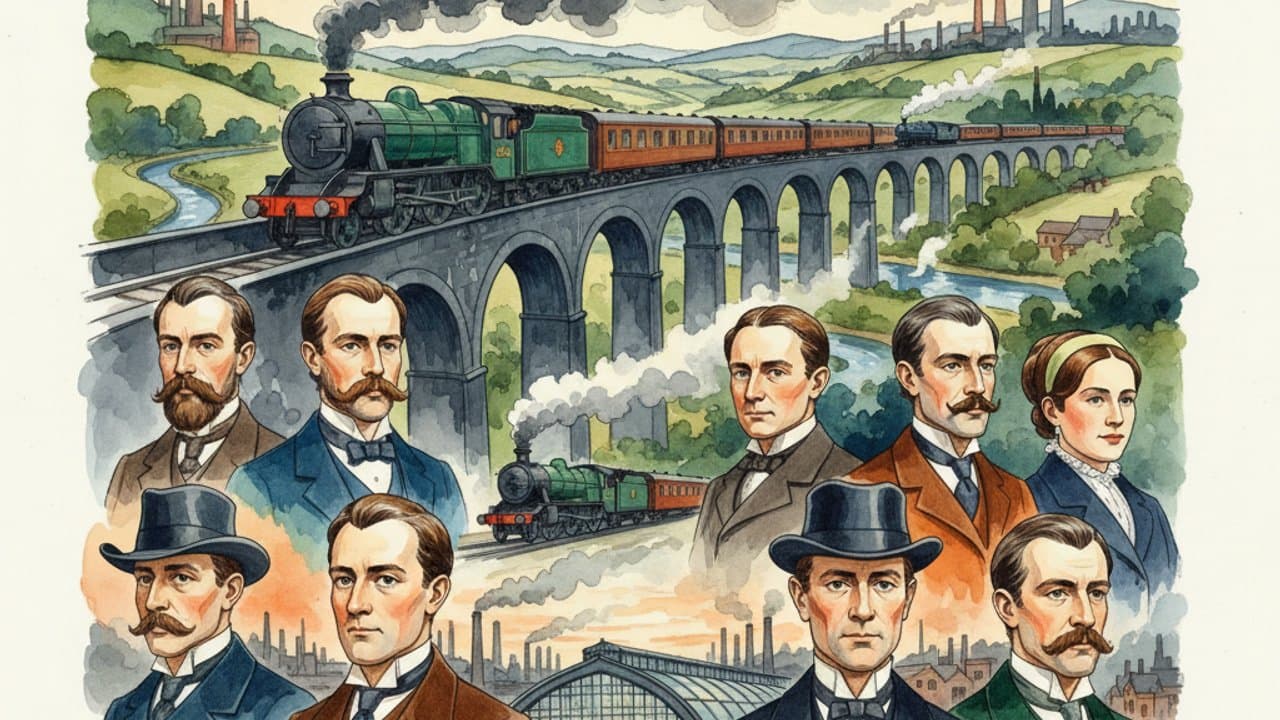
Standing on a platform today, it is easy to forget that almost everything you see was once just an idea in someone’s head. The steel rails, the powerful locomotives, the soaring station roofs, and the very route your train will take were all designed and built by remarkable individuals. These were the pioneers who, in less than a century, transformed Britain with a network of iron and steam.
They were engineers, architects, inventors, and organisers. Some were rivals, others were collaborators, but together they created the foundations of the railway system we still rely on. Here are ten of the most important figures whose vision and determination built Britain’s railways.
1. George Stephenson (1781-1848) Often called the “Father of Railways”, George Stephenson’s influence is difficult to overstate. Born into a poor mining family in Northumberland, he taught himself to read and write as a teenager and developed a brilliant understanding of machinery. His first job was to look after the steam engines that pumped water out of coal mines.
Stephenson was convinced that steam engines could be used for pulling wagons. In 1825, he was appointed chief engineer for the Stockton and Darlington Railway, the world's first public railway to use steam locomotives. His engine, Locomotion No. 1, pulled the inaugural train. A few years later, he engineered the more ambitious Liverpool and Manchester Railway. This was the first railway designed for passengers, travelling between two major cities. To find the best locomotive for the line, a competition was held, the famous Rainhill Trials of 1829. The engine he designed with his son Robert, the Rocket, was a triumph. Its advanced boiler and exhaust system was a groundbreaking design, forming the template for steam locomotives for the next 150 years.
Perhaps his most enduring legacy was his choice of track gauge (the distance between the rails). He chose 4 feet 8½ inches, the width used by the coal carts at his local colliery. This became known as ‘standard gauge’ and was adopted across Britain and much of the world.
2. Robert Stephenson (1803-1859) George Stephenson’s son, Robert, was an engineering genius in his own right. Unlike his self-taught father, Robert received a formal education and combined practical skill with advanced scientific theory. He was a key figure in refining the design of the Rocket and went on to establish the world’s first purpose-built locomotive factory in Newcastle upon Tyne.
While his locomotives were exceptional, Robert Stephenson is best remembered for his spectacular bridges. He had to find ways to carry railways across wide rivers and deep valleys. His High Level Bridge in Newcastle carries both a road and a railway on two separate decks. The Royal Border Bridge at Berwick-upon-Tweed is a magnificent stone viaduct. But his greatest achievement was the Britannia Bridge across the Menai Strait in Wales. To build it, he pioneered a new method, constructing two huge rectangular iron tubes through which the trains would run. The tubes were built on the shore and then floated into position before being lifted high onto stone towers. It was an extraordinary feat of engineering. Newspapers of the day followed its construction closely, printing detailed illustrations for an amazed public.
3. Isambard Kingdom Brunel (1806-1859) If the Stephensons were the practical founders, Isambard Kingdom Brunel was the railway’s great visionary. As Chief Engineer for the Great Western Railway (GWR), he was not content to simply follow the rules. He wanted to build the best railway in the world.
Brunel believed Stephenson's standard gauge was too narrow. For the GWR, he designed a much wider ‘broad gauge’ of 7 feet and a quarter inch, arguing it would allow for faster, smoother, and more stable trains. He then engineered a remarkably flat line from London to Bristol, nicknamed ‘Brunel’s Billiard Table’, to allow his express trains to reach high speeds. This involved creating incredible structures, including the Box Tunnel near Bath, which was over a mile long and the longest railway tunnel of its day. His Maidenhead Railway Bridge featured the widest and flattest brick arches ever built.
His ambition extended to his stations. He designed the original Bristol Temple Meads with its impressive mock-hammerbeam roof, creating a building that felt more like a grand hall than a simple shelter. Though his broad gauge was eventually replaced by standard gauge, Brunel’s pioneering spirit and magnificent structures remain a powerful part of our railway heritage.
4. Joseph Locke (1805-1860) Joseph Locke was a very different kind of engineer from Brunel. Where Brunel was a visionary who spared no expense, Locke was a pragmatist who prized speed and economy. He had trained under George Stephenson but developed his own methods for building railways quickly and on budget.
Locke’s approach was to follow the contours of the land more closely. He used steeper gradients and tighter curves to avoid the enormous cost of building long tunnels and giant viaducts. This method, sometimes called the ‘up and over’ school of engineering, meant his lines were often cheaper and faster to build than Brunel’s billiard tables. He engineered the Grand Junction Railway, which connected the Liverpool and Manchester Railway to Birmingham, creating the first trunk railway in the country. This line later became a vital part of the West Coast Main Line.
His work was central to the development of the railway network in the Midlands and North England. He was also responsible for planning the town of Crewe as a major railway junction and engineering works, a role it still holds today.
5. Thomas Brassey (1805-1870) While engineers designed the railways, someone had to actually build them. Thomas Brassey was the greatest of the railway contractors. He was a brilliant organiser who managed the logistics of building hundreds of miles of railway line. This involved hiring and managing huge workforces of labourers, known as ‘navvies’, and arranging for the supply of millions of bricks, tonnes of iron rail, and vast quantities of stone and timber.
At the height of his career, Brassey was responsible for building about one in every three miles of railway in Britain. He constructed large sections of the Great Northern Railway, the Caledonian Railway in Scotland, and many others. He was known for being a fair employer, and the quality of his work was legendary. His reputation for reliability and honesty was so great that he was invited to build railways all over the world, from Canada to Australia.
Brassey’s genius was not in design, but in execution. Without master organisers like him, the ambitious plans of the engineers would have remained just drawings on paper.
6. Sir Nigel Gresley (1876-1941) Jumping forward into the 20th century, Sir Nigel Gresley was a pioneer of a different kind. He was a master of steam locomotive design, focused on achieving new heights of speed and efficiency. As the Chief Mechanical Engineer of the London and North Eastern Railway (LNER), he created some of the most famous locomotives ever built.
His A3 Pacific class included the Flying Scotsman, which in 1934 became the first steam locomotive to be officially recorded travelling at 100 miles per hour. But Gresley wanted to go even faster. He developed the stunning, streamlined A4 class locomotives to pull high-speed services like the Silver Jubilee and the Coronation on the East Coast Main Line from London King's Cross. In 1938, one of his A4s, Mallard, set a new world speed record for steam traction of 126 miles per hour. It is a record that has never been broken.
Gresley’s engines were a perfect blend of power and elegance. They represented the peak of British steam locomotive design. Happily, a number of his creations, including both Flying Scotsman and Mallard, are preserved as part of the National Railway Museum's collection and can still be seen today.
7. William Henry Barlow (1812-1902) Every day, thousands of people rush through St Pancras International station in London, but few look up and appreciate the incredible roof above them. That roof was the masterpiece of civil engineer William Henry Barlow. When the Midland Railway built its new London terminus in the 1860s, it wanted a station that would make a statement.
Barlow’s challenge was to cover the platforms with a single, enormous roof, without any internal columns getting in the way of the trains. His solution was a magnificent arched train shed made of wrought iron and glass. When it was completed in 1868, it was the largest single-span structure in the world, stretching 74 metres from one side to the other. Its clever design, using a lattice of iron ribs, made it both immensely strong and surprisingly graceful.
This grand, open space set a new standard for station design. It showed that a railway station could be more than just a functional shed. It could be a cathedral of the industrial age, and Barlow’s pioneering work at St Pancras inspired architects and engineers across the globe.
8. Sir William Stanier (1876-1965) When the ‘Big Four’ railway companies were formed in 1923, the London, Midland and Scottish Railway (LMS) was the largest. However, it had a problem. It had inherited a confusing mix of locomotives from all its smaller founding companies. The man hired to solve this problem was William Stanier.
Lured from the GWR in 1932, Stanier brought modern design principles to the LMS. He created a new range of standard locomotives that were powerful, reliable, and easy to maintain. His most celebrated design was the LMS Class 5 4-6-0, better known as the ‘Black Five’. It was a true mixed-traffic engine, capable of pulling fast passenger services one day and heavy freight trains the next. Over 800 were built, and they became the backbone of the LMS fleet.
His larger 'Princess Coronation' class Pacifics were designed for the top express trains and were among the most powerful locomotives in the country. Stanier's work had a huge influence on later locomotive design, including the standard classes built by British Railways. His legacy was creating order from chaos and giving the LMS a fleet of truly excellent engines, like the ancestor of the BR Standard Class 5.
9. Timothy Hackworth (1786-1850) Timothy Hackworth was one of the very first railway pioneers, a contemporary of George Stephenson who deserves to be better known. He was a gifted and practical engineer from Shildon, County Durham, and was appointed the first locomotive superintendent of the Stockton and Darlington Railway.
While Stephenson was building the line, Hackworth was responsible for keeping the early, temperamental locomotives working. He was a dab hand at improving existing designs. His 1827 engine, the Royal George, was a huge step forward, being far more powerful and reliable than its predecessors. For the Rainhill Trials, Hackworth entered his own locomotive, the Sans Pareil. Although it was forced to withdraw with a cracked cylinder, it was a strong contender and impressed many who saw it run.
Hackworth later established his own engineering works in Shildon, building locomotives that were used on railways across the country. He was a key figure in proving that steam locomotives were a viable and powerful technology right at the dawn of the railway age. His work in the area around Darlington helped establish the North East as a centre of railway excellence.
10. Lewis Cubitt (1799-1883) Railways did not just need engineers, they also needed architects to design their great city stations. Lewis Cubitt was the architect who gave the Great Northern Railway its magnificent London terminus, London King's Cross, which opened in 1852.
At a time when many architects favoured elaborate, historical styles, Cubitt took a different approach. He created a design that was bold, simple, and functional. He believed the station’s appearance should reflect its purpose. The famous brick facade is dominated by two huge arches, which perfectly mirror the two train sheds behind them, one for arrivals and one for departures. There was no unnecessary decoration, just a clean and honest expression of the building's structure.
This was a very modern way of thinking. Cubitt’s design celebrated the engineering of the railway rather than hiding it behind a fancy disguise. The simple, practical layout has allowed King’s Cross to adapt and grow for over 170 years, which demonstrates the clarity and brilliance of his original vision.
These ten individuals are just a handful of the thousands of people who built Britain’s railways. Their combined legacy is a network that shaped the nation, changing how people travelled, lived, and worked. The next time you take a train journey, remember the pioneers whose ingenuity and hard work made it all possible.